


Sustainability Management Goals and Policies
 Economy
sustainable returns”
- Create electronic devices with smart, distinctive, unique innovation and deliver excellent quality products and services.
- Manage business to create innovations to create added value for customers and partners that will lead to mutual success on a global scale.
- Conduct business in accordance with good governance, transparency, accountability and taking into account all stakeholder groups.
- Manage holistic risk effectively.
- Manage and administrate the value chain with responsibility and sustainability.
 Society
and a sustainable society”
- Treat all employees with regard to human rights principles, equality, and safety at work.
- Develop personnel to promote career stability and create a good quality of life.
- Build a good relationship with the community and society, educate and develop the potential of youth and students who are important mechanisms in driving industry, economy, and society.
- Collaborate with educational institutions and government agencies to create innovations to bring about application of knowledge from research and development in practice to promote sustainable knowledge development.
 Environment
“A Low Carbon Company””
- Reduce environmental impact from operations and product processes throughout the supply chain.
- Focus on internal waste management and efficiently reduce waste from product manufacturing.
- Support and promote collaborative business operations with customers and partners, with a primary focus on environmental impact.
Double Materiality Assessment

Process for Identifying and Prioritizing Material Sustainability Issues
Defining and prioritizing key sustainability issues enables the effective formulation of the organization's sustainability strategies, goals, and risk management. The Company has adopted the Double Materiality assessment approach, considering Impact, Risk, and Opportunity (IROs) for each significant sustainability issue, in line with international best practices, namely the Corporate Sustainability Reporting Directive (CSRD). This directive encompasses both the Global Reporting Initiative (GRI) Standards and International Financial Reporting Standards (IFRS) Sustainability. This approach considers both the business operations' positive and negative impacts on stakeholders, society, and the environment (Impact Materiality), and external factors affecting the business's financial performance (Sustainability-related financial materiality).
The Double Materiality assessment process is divided into 7 main steps as follows:
The Company begins by clearly defining the objectives of the assessment, considering relevant regulatory requirements, and establishing the scope of stakeholder engagement and the organizational operations to be assessed. This ensures that both internal and external stakeholders are fully considered and that the assessment reflects a comprehensive perspective.
The Company compiles a list of potentially significant sustainability issues, referencing past assessments, industry standards, and stakeholder input. This step ensures that the Company can comprehensively identify relevant issues and that the assessment aligns with industry concerns and the organization's business context.
The Company categorizes the selected issues under main categories, namely Environmental, Social, and Governance (ESG). Additionally, the Company considers adding other related categories, such as Economic (to ensure comprehensiveness and facilitate subsequent analysis).
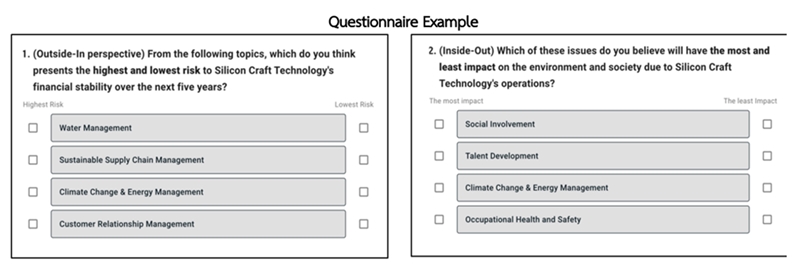
The Company develops a questionnaire to gather feedback from stakeholders and those involved with stakeholders, utilizing the MaxDiff Analysis comparison method. This approach helps mitigate the issue of similar scores across all topics, thereby enabling effective differentiation of the importance level of each Issue.
The survey is designed for respondents to select which issue is most important and least important within each group of topics, from four options. The survey is conducted from two main perspectives:
- Inside-Out Perspective (Impact Materiality): Assesses the impact of the Company's operations on stakeholders, the environment, and society.
- Outside-In Perspective (Sustainability-related financial materiality): Assesses the impact of external factors on the Company's operational performance.
This method enables the company to identify significant sustainability impacts across all dimensions, reduces the problem of score clustering, and enhances the accuracy of prioritizing various issues.
After collecting data from stakeholders, the Company converts the scores of each issue into numerical form for both dimensions. Subsequently, a Materiality Matrix diagram is created, illustrating the level of importance of each issue, with axes divided into impact on the company's operations and impact on environmental, social, and governance aspects. This diagram is further divided into low, medium, and high-risk zones to assist the Company in identifying the most critical issues.
The Company presents the assessment results to the board of directors and/or top management for review and approval of significant issues, including associated risks, to ensure that the prioritization of sustainability issues is appropriate and ready for disclosure.
The Company disseminates the assessment results to stakeholders and those involved with stakeholders, while also soliciting further feedback to effectively formulate sustainability strategies that address key issues. Furthermore, the Company conducts annual reviews of the assessment to keep pace with changes in the economy, society, and environment, and to address new potential risks.
Results of prioritizing significant sustainability issues for the Company and stakeholders
Double Materiality Matrix
Based on the aforementioned steps, the prioritization results of various issues, presented in the Double Materiality Matrix diagram from both Inside-Out and Outside-In perspectives, can be categorized by importance level as Low, Medium, High, as follows:
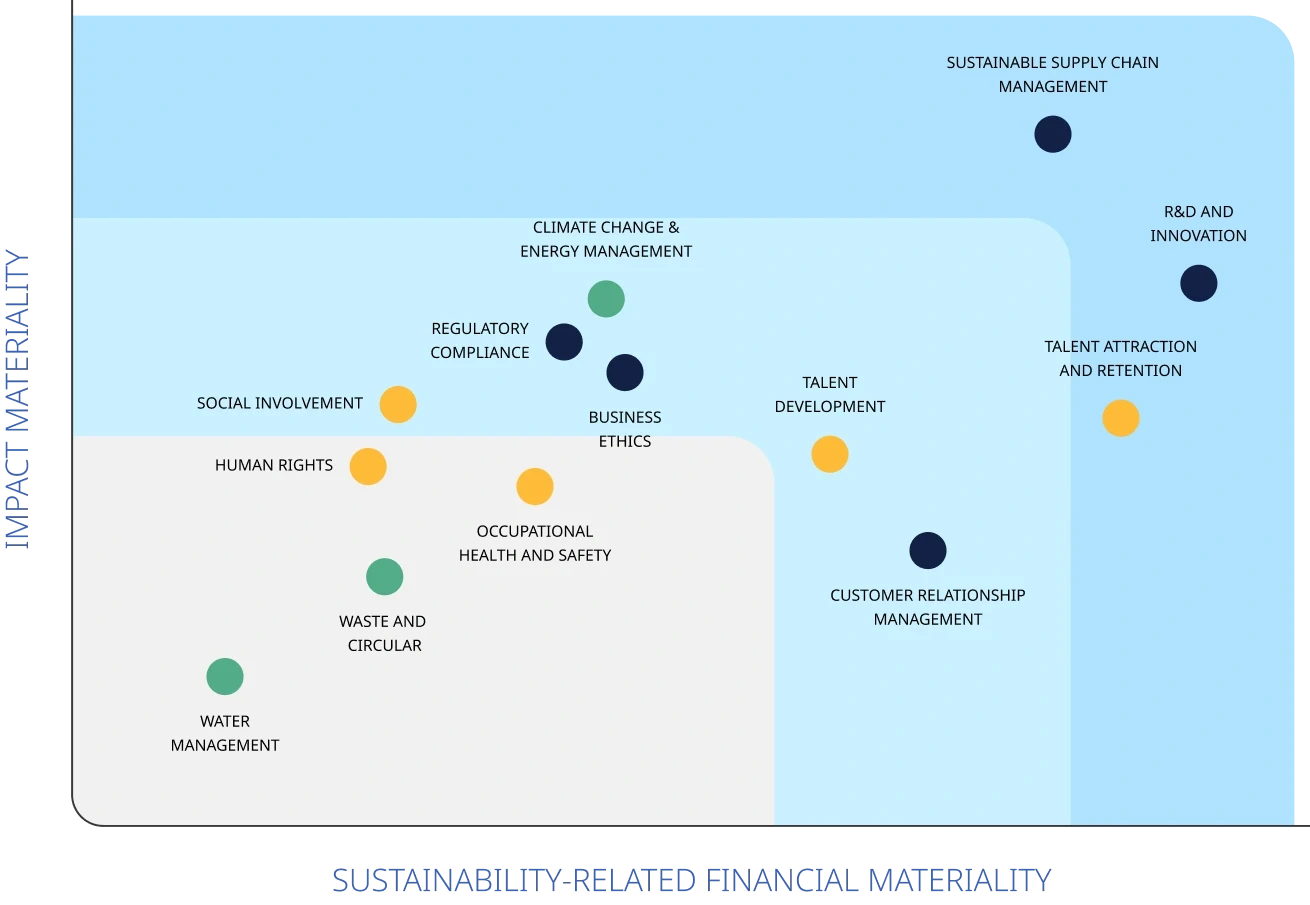
- High Materiality Issues with high impact on both the business and stakeholders include R&D and Innovation, Sustainable Supply Chain Management, Talent Attraction and Retention.
- Medium Materiality Issues with medium impact include Climate Change & Energy Management, Regulatory Compliance, Business Ethics, Talent Development, Customer Relationship Management, Social Involvement.
- Low Materiality Issues with low impact on the business or stakeholders include Human Rights, Occupational Health and Safety, Waste and Circular, Water Management.
Sustainability Key Performance